#8 TSURO OF THE SEAS

The basic game play of Tsuro of the Seas resembles that of Tom McMurchie’s Tsuro: Players each have a ship that they want to sail — that is, keep on the game board — as long as possible. Whoever stays on the board the longest wins the game.

Each turn players add “wake” tiles to the 7×7 game board; each tile has two “wake connections” on each edge, and as the tiles are placed on the board, they create a connected network of paths. If a wake is placed in front of a ship, that ship then sails to the end of the wake. If the ship goes off the board, that player is out of the game.

What’s new in Tsuro of the Seas are daikaiju tiles, representing sea monsters and other creatures of the deep. Notably, daikaiju can move: each tile has five arrows, four for moving in each of the cardinal directions and another one for rotation. On the active player’s turn, he rolls two six-sided dice; on a sum of 6, 7, or 8, the daikaiju will move, while on any other sum they’ll stay in place. To determine which direction the daikaiju tiles move, the player then makes a second roll, this time with a single die. On 1-5 in the second roll, each daikaiju moves according to its matching arrow. On a 6 in the second roll, a new daikaiju tile is added to the board.

If a daikaiju tile hits a wake tile, a ship, or another daikaiju tile, the object hit is removed from the game. Another way to be ousted! The more daikaiju tiles on the game board, the faster players will find themselves trying to breathe water…

sea

#9 BUBBLE TALK

Bubble Talk was the first game I played that took the Apples To Apples concept and added pictures to the mix.

In the party game Bubble Talk, the active player each round presents one of 150 images included in the game to the other players; these players then each choose one of the caption cards in their hands, and the active player decides which caption fits the image best, awarding the image card to the player who submitted that caption. Bubble Talk includes 300 different caption cards, with the captions presented in word balloons, aka, “bubble talk”.

This is a great game to pull out for people who really dont play games and they usually enjoy playing this one.bubble

#10 QWIXX/ROLL FOR IT

Coming in at number 10 is a tie between two dice games. I love both of these because they are easy to play and easy to teach. Plus they travel well. Just throw them in your purse or backpack and off you go. The first one is called Qwixx. I love this game because its a game that Robin and I have played together a lot. What is also cool is that you can get this game for less than $10.

Qwixx is a quick-playing dice game in which everyone participates, no matter whose turn it is. Each player has a scoresheet with the numbers 2-12 in rows of red and yellow and the numbers 12-2 in rows of green and blue. To score points you want to mark off as many numbers as possible, but you can mark off a number only if it’s to the right of all marked-off numbers in the same row.

On a turn, the active player rolls six dice: two white and one of each of the four colors listed above. Each player can choose to mark off the sum of the two white dice on one of their four rows, then the active player can choose to mark off the sum of one colored die and one white die in the row that’s the same color as the die. The more marks you can make in a row, the higher your score for that row. Fail to cross off a number when you’re the active player, however, and you must mark one of four penalty boxes on your scoresheet. If you mark off the 2 or 12 in a row and have at least five numbers marked in that row, you get to also mark off the padlock symbol in that row, locking everyone else out of this color.

When either a player has four penalty boxes marked or a second color is locked, the game ends immediately. Players then tally their points for each color, sum these values, then subtract five points for each marked penalty box. Whoever has the highest score wins.

Unknown


The other game is Roll For It. I had gotten this game when it was a kickstarter. It combines dice and cards and can also be found for under $10.

Roll For It! is a casual, family-friendly dice and card game. Each player starts the game with six dice of a single color, and three target cards are laid face-up on the table. Players take turns doing the following: On a turn, a player rolls all of her dice not already on cards, then places any dice that match the targets on the corresponding cards. (Alternatively, before taking her turn, a player can first choose to reclaim all of her dice from all cards.)

If the player now fulfills the target with her dice – e.g., a pair of 3s, a quartet of 6s, or a specific combination of numbers – she claims the card, takes back her dice (and returns any other dice on the card to their owner), then places a new card on the table. Each card is worth a certain number of points. The first player to earn forty or more points wins!

There are two sets of Roll For It! available — the red set comes with translucent dice and the purple set comes with pearl dice. There are no duplicate cards between the sets. Each set allows play for 2-4 players, but when they are combined, up to eight players can compete in the same game of Roll For It!

pic1807047_md


March Blog

February I  did the games I played growing up. For March I will  list the top 10 games that I’m currently playing starting with the next post. Stay Tuned. I would also love to hear what games that you may be playing or what are some of your favorites.

Honorable Mention Board/Card Games Growing Up

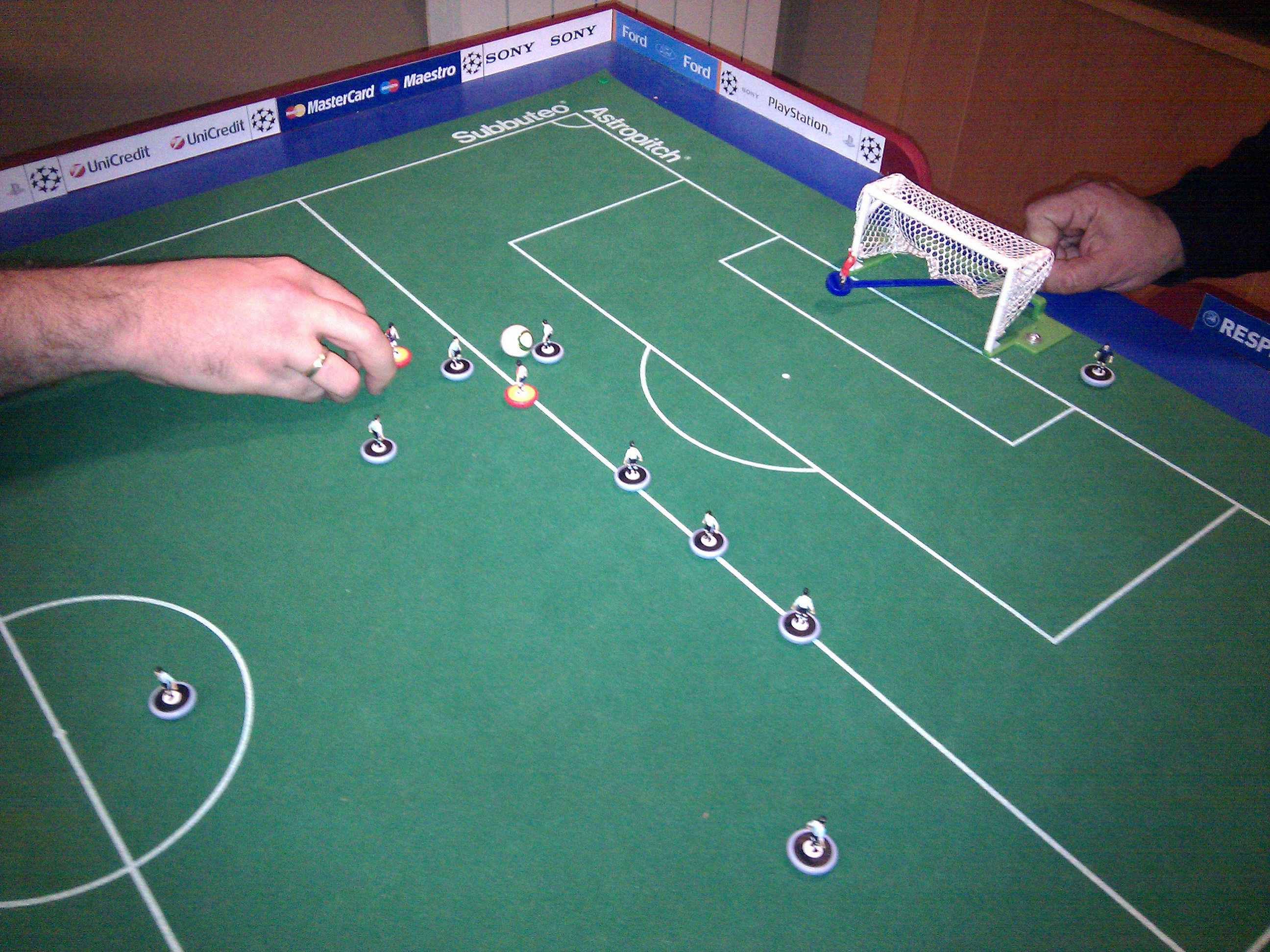
Subbuteo is a classic finger-flicking football-simulation action game. It is played on a large cloth playing field called a “pitch”, with teams of players that are represented by miniature men mounted on smooth round bases. The men are made to kick the ball by flicking their bases, which causes the men to slide around on the pitch, hitting the ball. The rules simulate nearly all details of a soccer game including ball possession and passing, throw-ins, goal kicks and corner kicks. There is even a large section in the rules devoted to fouling.

Far more popular in European countries than in the United States, this game allows collectors to buy teams of men representing dozens of teams and countries from around the world, along with soccer stadium enhancements such as stands filled with cheering fans, referees that stand on the sidelines, even stadium lights.

Subbuteo_arenys_de_munt


Stay Alive The game consists of a 7×7 board with horizontal and vertical slides that can be in any of three positions each. Each slide has a certain number of holes in it. Initially, the board is set up in any random position, then the players deploy their marbles onto the non-holed spaces. On your turn, you change a slider’s setting, hoping to open new holes underneath opponents’ marbles. The last player to Stay Alive wins.

Basket,

bask

Battleship,

Battleship was originally a pencil-and-paper public domain game known by different names, but Milton Bradley made it into the well known board game in 1967. The pencil and paper grids were changed to plastic grids with holes that could hold plastic pegs used to record the guesses.

Each player deploys his ships (of lengths varying from 2 to 5 squares) secretly on a square grid. Then each player shoots at the other’s grid by calling a location. The defender responds by “Hit!” or “Miss!”. You try to deduce where the enemy ships are and sink them. First to do so wins.

Mastermind,

mm

Stratego,

ss

Sorry,

Race your four game pieces from Start around the board to your Home in this Pachisi type game. By turning over a card from the draw deck and following its instructions, players move their pieces around the game board, switch places with players, and knock opponents’ pieces off the track and back to their Start position.

Slides are located at various places around the game board. When a player’s piece lands at the beginning of one of these slides not of its own color, it automatically advances to the end, removing any opponent’s piece on the slide and sending it back to Start.

Game moves are directed exclusively by cards from the play-action deck. If one plays the normal version in which one card is drawn from the deck each turn, the outcome has a huge element of luck. Sorry can be made more of a strategic game (and more appealing to adults) by dealing five cards to each player at the start of the game and allowing the player to choose which card he/she will play each turn. In this version, at the end of each turn, a new card is drawn from the deck to replace the card that was played, so that each player is always working from five cards.

A player’s fortunes can change dramatically in one or two rounds of play through the use of Sorry cards, the “11” cards (which give the player the option of trading places with an opponent’s piece on the track), and the fact that it is possible to move from Start to Home without circumnavigating the full board by making judicious use of the “backward 4” cards.

PayDay,

Pay Day is played on a one-month calendar with 31 days. During the game, players will have to deal with various bills and expenses, but will also have the opportunity to make deals on property and earn money. At the end of each month, players are paid their salary (the same for each player) and must then pay off all outstanding bills, taking out a loan if necessary. Most money (or least debt) wins after a certain number of months decided by the players (3 months usually takes 30 minutes to finish).

Chineese Checkers,
check

KerPlunk

ker

#1 Board/Card Game Growing Up

DUNGEONS AND DRAGONS

When I first played this game I was blown away. You really had to use your imagination and the different dice you had to roll. Plus you used paper and pen to play. And the miniatures were so cool. I loved getting and painting the figures. And the best part was playing with my friends. As time went by, the game blew up in popularity and controversy. But before I got caught up into all the hype and controversy, I had found a new hobby. That Hobby was video games and pinball. Most of my focus had shifted from board games to video games. But that can be another Blog Subject 🙂

dd

#2 Board/Card Game Growing Up

RISK/CHOPPER STRIKE

Possibly the most popular, mass market war game. The goal is conquest of the world.

Each player’s turn consists of:
– gaining reinforcements through number of territories held, control of every territory on each continent, and turning sets of bonus cards.
– Attacking other players using a simple combat rule of comparing the highest dice rolled for each side. Players may attack as often as desired. If one enemy territory is successfully taken, the player is awarded with a bonus card.
– Moving a group of armies to another adjacent territory.

risk

I had to put Chopper Strike too. It was my first real battle and strategy game and Im still on the hunt for this game today.

cs

In this game, each player manoeuvres a fleet of helicopters and a fleet of jeeps (equipped with AA guns), trying to gain air or ground superiority. That is to say, you win by wiping out all of your opponent’s choppers or all of his jeeps.
A d3 indicates how many pieces you will move, and a d6 how far each one will move. Choppers move on the elevated “air” board, whilst jeeps stick to the ground. Terrain obstacles complicate matters for the jeeps at the players’ “border”. Choppers take choppers out by jumping over them (à la checkers); they can also take jeeps out by bombing them (stopping right above them). Jeeps take jeeps out by landing on them; they can also take choppers out using their AA guns (stopping right below them).

#3 Board/Card Game Growing Up

CAREERS

I like it because it was a more intense game then Life.

Careers is a game where the players set their own victory conditions. A player may choose to pursue Fame, Happiness, Money, or a combination of all three. The limitation being that the total number of “points” earned in the 3 categories must total 60. eg. 60 Happiness, 0 Fame, 0 Money; 20 of each; or any other combination. The players endeavor to fulfill their goal by going through any number of different “occupation paths”. All paths have some prerequisite for entry, and benefits accrue from going through any of the paths more than once. The different occupations are designed to be suited to different strategies, eg. Hollywood is good for fame points, while “Going to Sea” is good for happiness. In the end it is the player (or team of players) who gets to their pre-set goal first who will be the winner, and achieve everything they ever wanted in life.

careerscar

#4 Board/Card Game Growing Up

GAME OF LIFE

I loved the spinner and cruising around with the car and people in it.

This game attempts to mirror life events many people go through from going to college, raising a family, buying a home, working and retiring.

The intent of the game is to have the most assets at the end of the game, assets are earned primarily by working and earning tokens with dollars amount on them. Additionally the first person to complete the course gets additional money tokens.

There is a very linear board that you move along by spinning a wheel or landing on spaces that tell you to move to a specific space or forward or back. There are a handful of intersections where you can choose to go one direction or another but they ultimately have similar spaces and meet back up quickly. There are a handful of choices regarding insurance and investments but for the most part it is a game of luck.

life

#5 Board/Card Game Growing Up

Trouble

All I have to say is Pop -O -Matic Dice Roller.

This is the game with the Pop-O-Matic dice roller. It’s a simplified Pachisi variant in which only one die is rolled per turn.

The game is abstract, each player has set of pawns of his color. Each turn player rolls a die using the Pop-O-Matic and selects one of his pawns to move. Pawns can enter the track from Home base only on a roll of six. Each pawn needs to travel around the board and finish on the Finish lane. If pawn of another player is bumped, the bumped pawn is returned to home. The goal is to be the first one to get all the pawns to the Finish lane.

For advanced players, we suggest that when a piece gets bumped, it should only be bumped back to its START space, rather than to its HOME. Only when bumped from their START space are pieces sent HOME.

trouble

YIKES, HADLEY!

ENGLISH IS HARD.

littlehannie

My brain. Simple as that.

I Need A Game Night!

All games All The Time